A clear view: How Reading glasses change lives
Published on August 26, 2026
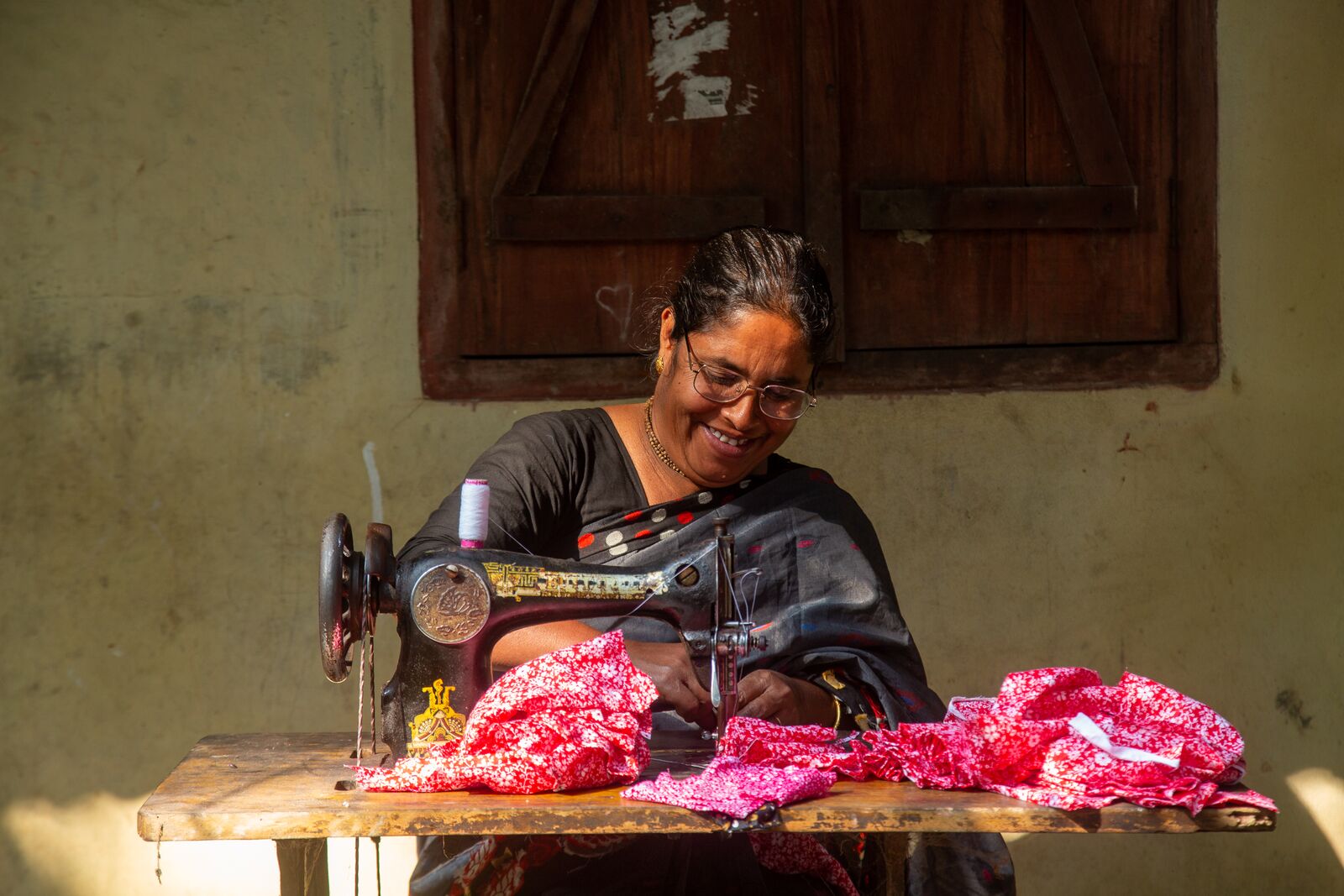
Kalpona Khatun was in her early forties when her vision began to blur. Daily tasks became challenges, from making food for her two children to the occasional sewing work that provided additional income for her family. Eventually she had to give up work altogether. Kalpona’s husband supported her as best he could, but neither of them knew where to seek help. Over time, Kalpona’s confidence diminished and she felt increasingly helpless.
There are a billion people around the world with similar stories. A billion people who need glasses but don’t have them. For many of these people, deteriorating eyesight means a steady fall in income, whether they’re artisans, craftspeople, accountants, shopkeepers or construction workers in low-income communities. They should be at the peak of their professional productivity and skill in their late forties - an age at which four out of five people worldwide need reading glasses - but many struggle to keep a job because they simply can’t see clearly.
This creates pain, anxiety and hardship for the affected individuals and their families. And it’s a colossal waste of potential for society. The World Health Organization estimates that impaired vision costs the global economy more than USD 200 billion every year.
A quarter of a century ago, the international non-profit VisionSpring set out to find a solution to this problem. Its aim is crystal-clear today: to ensure that by 2050, anyone who needs glasses will have them. Its approach is simple: through partnership with NGOs and government agencies, VisionSpring trains community health workers who carry out free sight tests in vulnerable, low-income communities, and sell affordable, quality glasses to those who need them. Its impact, however, goes much deeper. “Eyeglasses are a tool. What we really do is increase lifelong learning, earning, safety and well-being for people vulnerable to poverty,” explain Ella Gudwin, VisionSpring’s CEO.
Since its inception, VisionSpring has provided more than 16 million people with glasses worldwide. We have supported VisionSpring’s transformative work since 2018, with three successive grants focused on its “Reading Glasses for Improved Livelihoods” programme in Bangladesh. This programme sees Community Health Workers – rather than specialist optometrists – carrying out free vision tests in rural communities and selling low-cost reading glasses to those who need them.
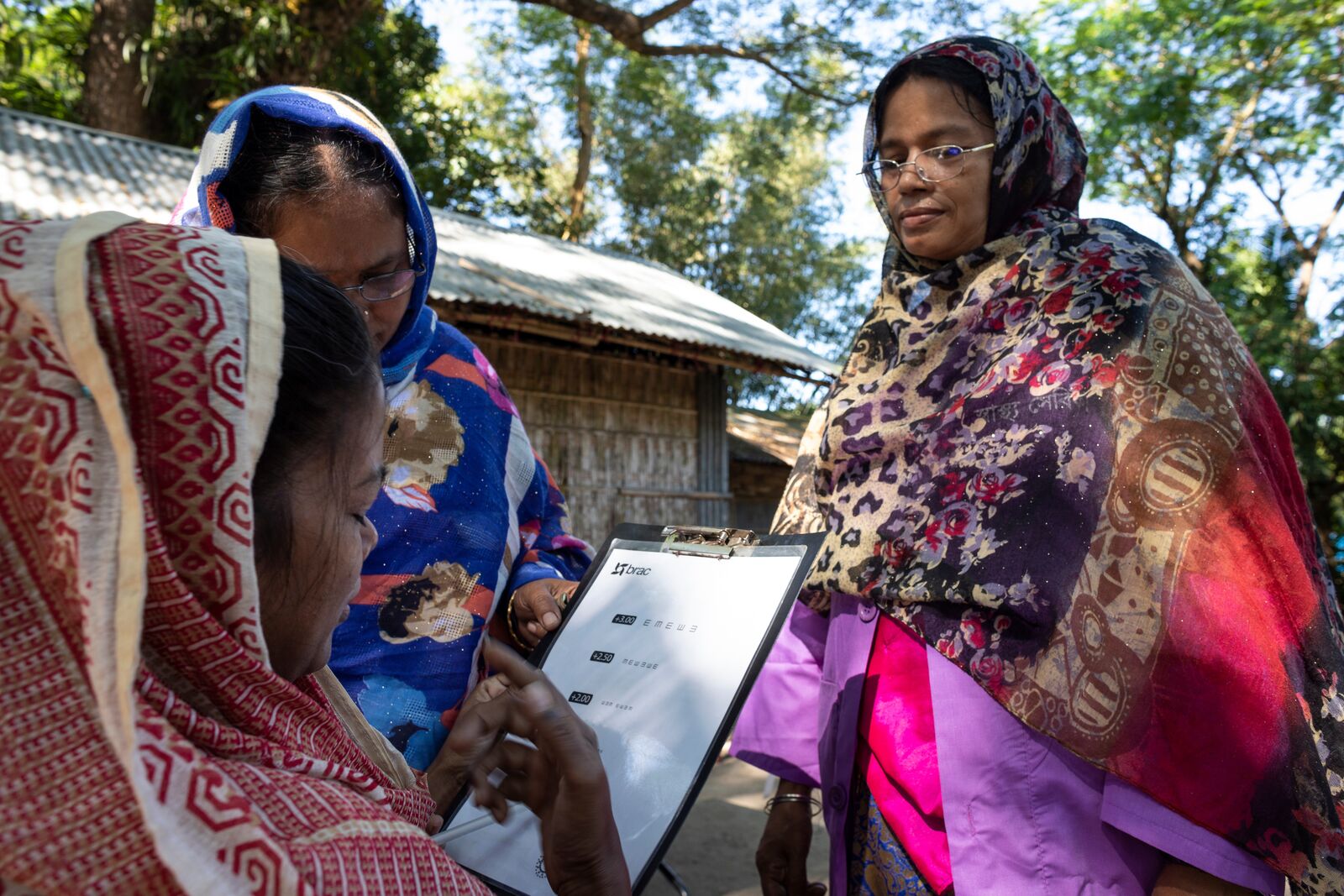
Kalpona Khatun’s life changed when she heard about one of the vision screening camps that VisionSpring and its partner BRAC had organised in her village. Upon learning of Kalpona’s struggles, BRAC’s local field organiser encouraged her to visit the camp and have her eyesight tested.
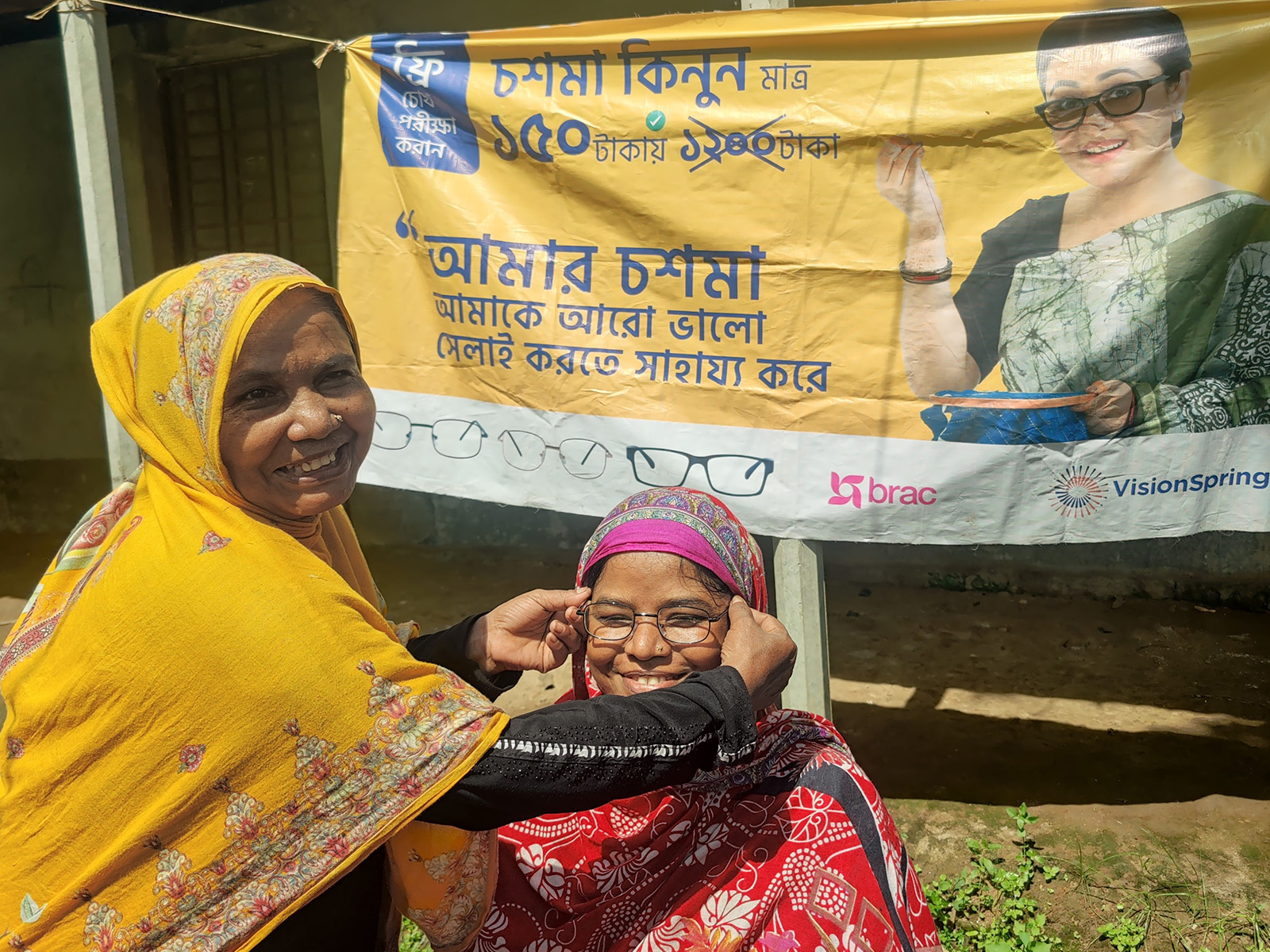
At the camp, the free test quickly revealed that Kalpona was affected by presbyopia, a common age-related condition which makes it difficult to focus on nearby objects. The solution was simple and affordable: a pair of reading glasses costing just 150 Bangladeshi taka – around 1 US dollar. When Kalpona tried the glasses on her face lit up with joy: she could see clearly again. She quickly returned home to tell her husband, who warmly supported her decision, and within half an hour she was back with the money and a bright smile, ready to pick up her glasses.
For Kalpona, seeing clearly has brought a multitude of benefits: “Now I can read the Quran more clearly and hope to improve my sewing work and earn more to support my family. I can also use my phone better and see things up close. I feel more confident in my daily life.”
Ella Gudwin
CEO, VisionSpring

The data confirmed what we kept hearing from customers like Kalpona Khatun – that access to glasses changes lives. This spurred us on to scale our work further and reach even more people.
Ella Gudwin
CEO, VisionSpring
Kalpona is one of more than 2.4 million people in Bangladesh who have been able to purchase affordable reading glasses thanks to VisionSpring, in many cases improving their quality of life and income-earning potential as a result. A rigorous impact study published in 2024 showed that people across rural Bangladesh who received a pair of reading glasses – including farmers, artisans, tradespeople and small entrepreneurs – saw their income increase from a median of around USD 35 to USD 47 a month, an average of 33.4%. Meanwhile, people who needed glasses but had not yet received them did not achieve any significant income gains during the period. Participants who received glasses also reported feeling better about their lives overall, enjoying a greater sense of independence and ease when doing daily tasks.
“The data confirmed what we kept hearing from customers like Kalpona Khatun – that access to glasses changes lives. This spurred us on to scale our work further and reach even more people,” says Ella Gudwin.
In Bangladesh, this scaling work is already under way – both horizontally, by expanding into new districts, and vertically, by working to increase the rate at which people take the opportunity to get tested and purchase glasses if they need them.
“For years, we observed an interesting phenomenon when holding vision screening camps. Firstly, a lot of people of the age at which vision problems tend to occur did not show up to get tested, especially men. And secondly, only around two in four of those who got tested and diagnosed with blurry near vision (presbyopia), actually purchased glasses.”
With the help of behavioural science specialists from Appleseed and WRP, VisionSpring’s teams have been able to unpack the reasons for these challenges and develop strategies to get more people to show up, get tested and buy glasses.
“For example, we discovered we need to be more present in the communities to mobilise people in advance of the vision screening camps. One simple tool that has been very effective in this regard is to hand out individual appointment cards with time slots – it turns the screening into a personal consultation,” Ella Gudwin explains. "We also learned that we needed to tweak our messaging: people with blurry near vision often normalize their condition and aren’t necessarily aware that there are simple solutions which improve their quality of life without any need to see a doctor. Accordingly, we’ve invested in creating the right communications materials and in training Community Health Workers in customer interactions and sales techniques that help address any misconceptions.”
The preliminary results of these strategies to build demand and reduce barriers to people buying glasses are highly encouraging: VisionSpring has delivered 36% more screenings across four pilot districts in just four months, achieving a 79% increase in people buying glasses if they need them, and 185% growth in total sales. It has since rolled these approaches out across Bangladesh, reaching over 300,000 people.